
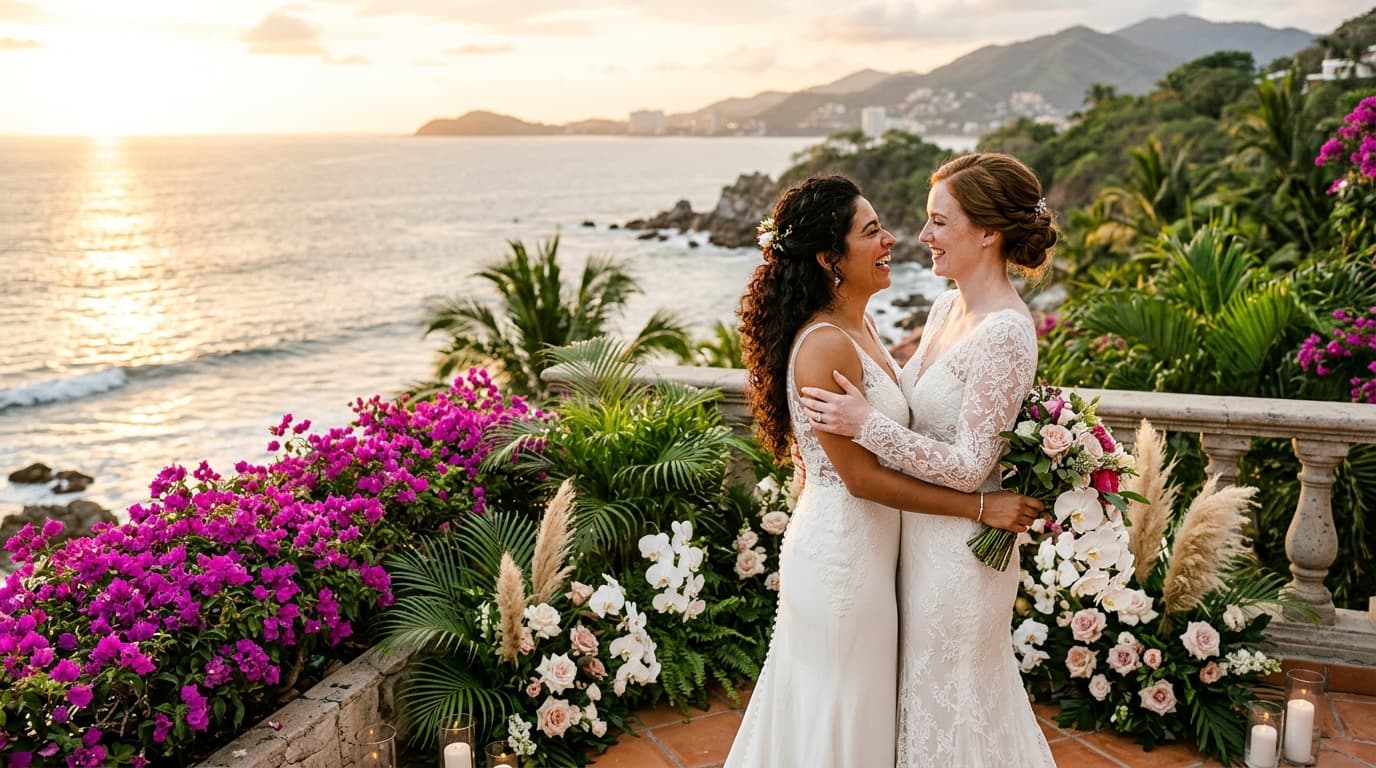
The Intersect of Luxury Estate Architecture and Federal Maritime Law
Hosting an ultra-luxury wedding at a private coastal estate in Puerto Vallarta offers an incomparable blend of intimacy, residential grandeur, and direct access to the Pacific Ocean. Estates along the South Shore—specifically within Lower Conchas Chinas, Punta Negra, and the gated enclaves of Playas Gemelas—often feature dramatic infinity pools and manicured lawns that appear to merge directly into the golden sands of Banderas Bay. However, high-net-worth couples and elite event designers must navigate a critical legal landscape when planning ceremonies that extend past the private property line and onto the sand: Mexico’s Zona Federal Marítimo Terrestre (ZOFEMAT).
In Mexico, all beaches are constitutionally public, governed by federal environmental law under the jurisdiction of SEMARNAT (Secretaría de Medio Ambiente y Recursos Naturales). The ZOFEMAT boundary comprises the 20-meter strip of land contiguous to the highest tide mark. While a private villa owner holds clear title to their real estate, their rights over the adjacent beach depend entirely on federal concession agreements. Executing a flawless beachfront ceremony or sunset cocktail hour requires a precise understanding of ZOFEMAT compliance, environmental protection protocols, and municipal coordination.
Understanding ZOFEMAT Concessions and Temporary Event Permitting
When selecting a luxury villa for a destination wedding in Puerto Vallarta, confirming the estate’s current federal beach concession status is the foundational first step. Private estates generally fall into three categories regarding their beachfront access:
- Active Exclusive Concession: The property owner holds an active federal lease for the contiguous ZOFEMAT strip, allowing restricted private usage and streamlined permitting for temporary events.
- Non-Concessioned Public Buffer: The villa abuts public beach area without an active private concession, requiring independent, temporary event permits directly from SEMARNAT and municipal authorities.
- Protected Ecological Zone: The adjacent beach falls within critical biological zones—such as sea turtle nesting grounds—requiring specialized environmental impact mitigation plans before any temporary structures can be placed.
Securing a Permiso Provisorio para Eventos Especiales (Temporary Special Event Permit) requires filing applications 90 to 120 days prior to the event date. This application must detail the exact square footage utilized, exact hours of occupation, structural load diagrams for non-permanent installations, and comprehensive waste management protocols. Navigating this bureaucratic pipeline through local Puerto Vallarta municipal offices and federal SEMARNAT delegates demands deep regional expertise to prevent last-minute enforcement interventions from PROFEPA (Procuraduría Federal de Protección al Ambiente).
Tide Table Dynamics and Non-Permanent Architectural Placement
Designing an elevated ceremony footprint on the sand involves balancing artistic vision with coastal hydrodynamics. Banderas Bay experiences significant seasonal shifts in tidal amplitude, driven by lunar cycles and offshore swells coming off the Cabo Corrientes peninsula. The mean high-water mark (Pleamar) can shift oceanward or landward by several meters between the dry winter months and the late-summer swell season.
Calculating Safe Setback Distances
To avoid structural erosion or ocean spray interference during the exchange of vows, production teams must calculate precise setback distances from the dynamic water line. Structural elements—including ceremony platforms, hardwood runners, and floral arbors—must sit comfortably above the predicted tidal high for that specific hour. Rigorous site assessments evaluate the soft sand compression ratios, ensuring that weighted floral installations remain perfectly level throughout the event duration.
Zero-Footprint Engineering on Federal Sand
Federal regulations strictly prohibit driven stakes, concrete footings, or permanent alterations within the ZOFEMAT boundary. Luxury production teams must utilize zero-impact load distribution methods:
- Internal Water or Sand Ballast Systems: Mandrels and timber arbors are secured using disguised, high-capacity internal weight bladders concealed within custom cabinetry or dense floral bases.
- Freestanding Modular Decking: Interlocking hardwood platforms distribute weight evenly across the sand substrate without requiring subterranean anchors or damaging coastal vegetation.
- Leave-No-Trace Stripping Schedules: Federal compliance mandates that all event infrastructure must be entirely dismantled and removed within four hours of event conclusion, returning the beach to its natural state.
Environmental Protection Protocols and Sea Turtle Conservation
Puerto Vallarta's South Shore serves as a crucial nesting habitat for the endangered Olive Ridley sea turtle (Lepidochelys olivacea). The primary nesting season spans from July through December, overlapping directly with late-summer and autumn luxury wedding schedules. Operating a luxury event within a ZOFEMAT zone during nesting season triggers strict environmental compliance oversight.
Sea Turtle Nesting Mitigation
If a villa’s beachfront area coincides with active nesting sites, all evening event planning must comply with guidelines established by local marine biologists and the Campamento Tortuguero. Key operational mandates include:
- Warm-Spectrum, Low-Lumen Lighting: Traditional halogen or cold-white LED fixtures disorient nesting females and emerging hatchlings. All perimeter and task lighting placed on the sand must utilize narrow-spectrum amber or red LEDs under 590 nanometers, directed downward.
- Vibration and Foot-Traffic Controls: Designated pathways built over raised timber decks prevent sand compaction over undetected underground clutch sites.
- On-Site Biological Monitoring: For high-budget coastal productions, engaging a certified local marine biologist ensures that any active nest identified within the setup zone is legally relocated to a protected hatchery prior to load-in.
Integrating Private Maritime Access and Capitanía de Puerto Protocols
For secluded cliffside villas in area enclaves like Mismaloya or Sierra del Mar at the Sea where land access for large guest lists is restricted, arriving via private yacht or water transfer offers an extraordinary arrival sequence. However, launching tender boats or establishing temporary floating docks within the ZOFEMAT zone requires authorization from the Capitanía de Puerto (Port Captain).
Maritime transfers must align with local water depth profiles and marine currents. Certified maritime logistics coordinators manage vessel anchoring outside the surf line, using specialized shallow-draft tenders equipped with dynamic positioning to transfer guests smoothly onto temporary gangways. Ensuring these maritime operations run in harmony with ZOFEMAT land permits guarantees an uninterrupted, legally compliant luxury experience from sea to estate.