
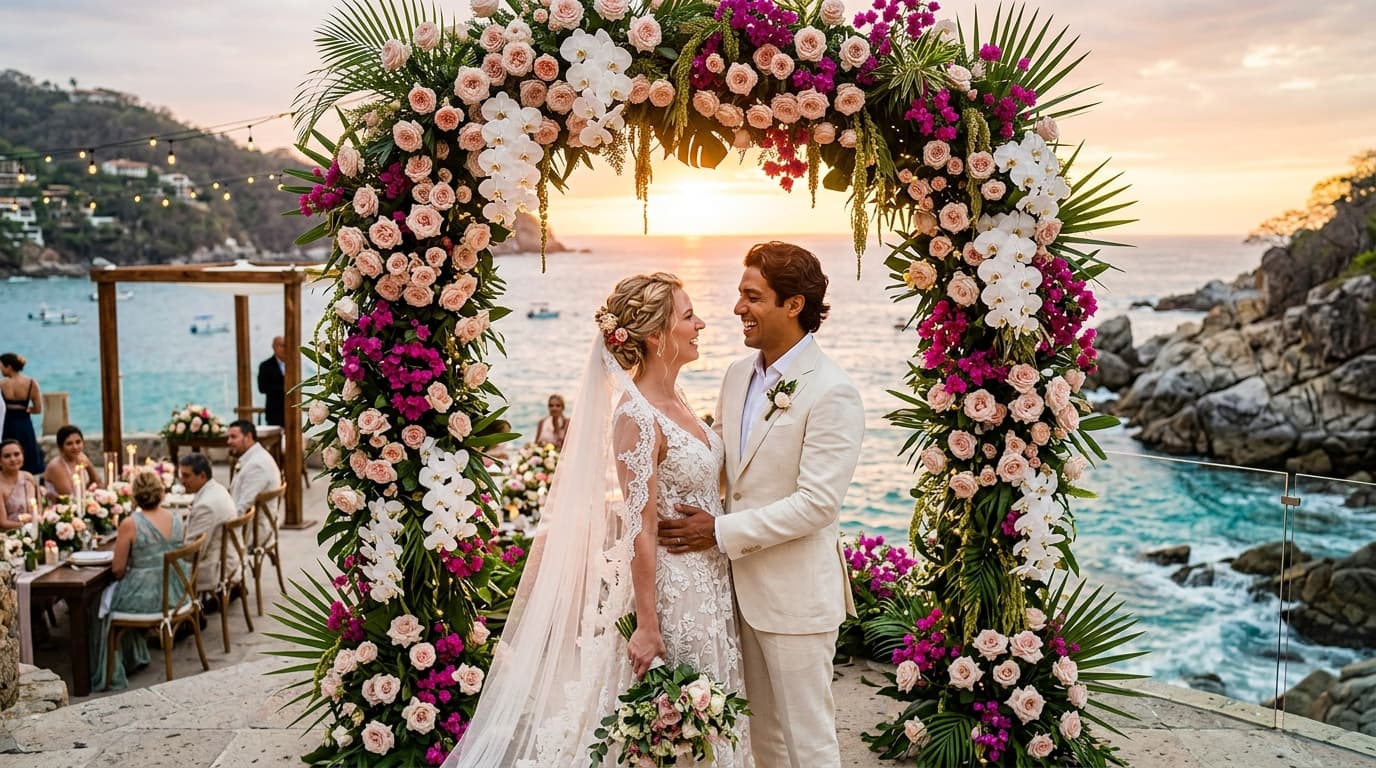
Executing a high-concept botanical transformation within a private oceanfront estate in Puerto Vallarta demands an intimate mastery of localized microclimates. While the sheer cliffs of Conchas Chinas and the secluded coves of Mismaloya offer unmatched backdrops of granite rocks and azure waters, Banderas Bay’s atmospheric conditions present unique challenges for high-end floral installations. Sub-tropical ambient humidity, elevated ambient temperatures, salty sea spray, and relentless coastal wind can rapidly compromise delicate floral tissue if not addressed with rigorous scientific and creative planning.
For luxury destination couples, an exquisite floral installation must look as crisp and vibrant during the midnight afterparty as it did when the bride walked down the aisle at dusk. Achieving this level of botanical perfection in a private villa setting requires an advanced approach to cold-chain logistics, vascular stem saturation, species selection, and environmental structural staging.
The Logistics of Sub-Tropical Cold-Chain Transport
The journey of luxury floral material to a private villa in Puerto Vallarta begins long before stems reach the estate gates. Ultra-premium varieties—such as Dutch garden roses, Japanese sweet peas, Italian ranunculus, and French hydrangeas—are inherently vulnerable to heat stress. Sourced primarily from specialized growers in Central Mexico or imported via Mexico City (MEX) and Guadalajara (GDL), these delicate blooms must remain within an unbroken cold chain.
Unlike commercial resort venues with built-in industrial refrigeration, private villas in areas like Amapas or Sierra del Mar require specialized mobile cold storage solutions. Premier floral design teams utilize temperature-controlled transport vehicles maintained at precise temperatures (34°F to 38°F) with calibrated humidity levels. Upon arrival at the villa, temporary, climate-controlled prep spaces must be established—often converting air-conditioned estate garages or interior suites into pop-up botanical labs—to allow blooms to acclimate gradually without experiencing thermal shock.
Vascular Saturation and Ephemeral Botanical Hydraulics
Once inside the private estate, the mechanical preservation of each bloom depends on custom botanical hydraulics. In sub-tropical climates, cut flowers lose moisture through transpiration at nearly double the rate of temperate environments. To combat this, master florists employ specialized conditioning protocols designed to maximize cellular turgor pressure:
- Deep-Stem Recutting and Thermal Shock Baths: Stems are recut under water at a 45-degree angle to eliminate air embolisms within the xylem. Certain woody stems undergo quick-dip thermal immersion to clear latex or sap blockages.
- Hydrophobic Anti-Transpirant Sealants: Delicate petals receive micro-mists of organic anti-transpirant formulas. These invisible, non-toxic polymers form a vapor-permeable membrane over the foliage and petals, drastically slowing water loss without affecting natural sheen or color depth.
- Nutrient-Rich Hydration Buffers: Stems are hydrated in customized water solutions balancing pH levels, biocide controls to eliminate bacterial blooms, and precise carbohydrates that nourish the cellular structure.
Engineering Microclimates for Villa Installations
In an open-air oceanfront villa, static floral arrangements are subject to localized environmental stressors. Designing suspended floral chandeliers over an infinity pool patio or wrapping expansive terrace columns in living botanical sculptures requires microclimate mitigation engineering.
Deflection of Marine Wind and Saline Spray
Coastal breezes rushing off Banderas Bay carry microscopic salt crystals that dehydrate floral tissue rapidly. To protect grand altar arches and aisle installations in open-air venues like Punta Mita or South Zone estates, structural designers position subtle, clear acrylic wind deflectors or leverage existing estate architecture (such as stone retaining walls or glass balustrades) to create ambient air buffers. This reduces direct wind shear across delicate petals while preserving unobstructed ocean vistas.
Integrated Sub-Surface Hydration Systems
Gone are the days of relying solely on traditional floral foam, which degrades quickly in direct sun. Contemporary sustainable design in private estates utilizes hidden, high-capacity water reservoirs, sealed capillary mats, and micro-drip irrigation lines integrated directly into large-scale structural frames. These systems continuously feed moisture to stem bases throughout the heat of the afternoon, ensuring lush greenery and heavy blooms remain fully hydrated from the afternoon ceremony through the late-night reception.
Harmonizing Native Resilience with Imported Luxury
A sophisticated botanical narrative for a Puerto Vallarta villa wedding balances fragile imported stems with hyper-local, climate-resilient flora. Integrating indigenous Mexican botanicals not only grounds the aesthetic in the rich bio-density of the Jalisco coast, but also provides structural integrity that withstands coastal humidity.
- Native Architectural Elements: Cascading local bougainvillea, wild monstera deliciosa, king anthuriums, and native bromeliads offer exceptional structural durability and natural resistance to coastal air.
- Textural Layering: Striking native orchids (such as Laelia rubescens) and local ginger blossoms seamlessly weave through softenings of imported white O’Hara garden roses, cosmos, and delicate trailing greenery.
- Seasonal Adaptation: During the warmer shoulder months (May and October), florists adjust ratios to feature a higher percentage of tropical and sub-tropical botanicals, utilizing imported blooms primarily in high-visibility, sheltered focal points.
Timelines for Estate Botanical Assembly
Unlike ballroom venues where installations can be constructed days in advance, oceanfront estate installations operate on hyper-calibrated timelines. Heavy structural rigging and foam-free mechanics are constructed on-site 24 to 36 hours prior to the event. However, sensitive live botanical materials are inserted into structures during a strict multi-stage window:
Foliage and climate-hardy stems are placed during the early morning hours before peak thermal intensity. Fragile floral focal points—such as garden roses, peonies, and orchids—are added in late afternoon, precisely two to three hours before guest arrival. This synchronized timeline guarantees that every bloom opens to its absolute peak moment as the sun begins its dip below the Banderas Bay horizon, delivering a breathtaking visual experience for an unforgettable luxury villa celebration.