
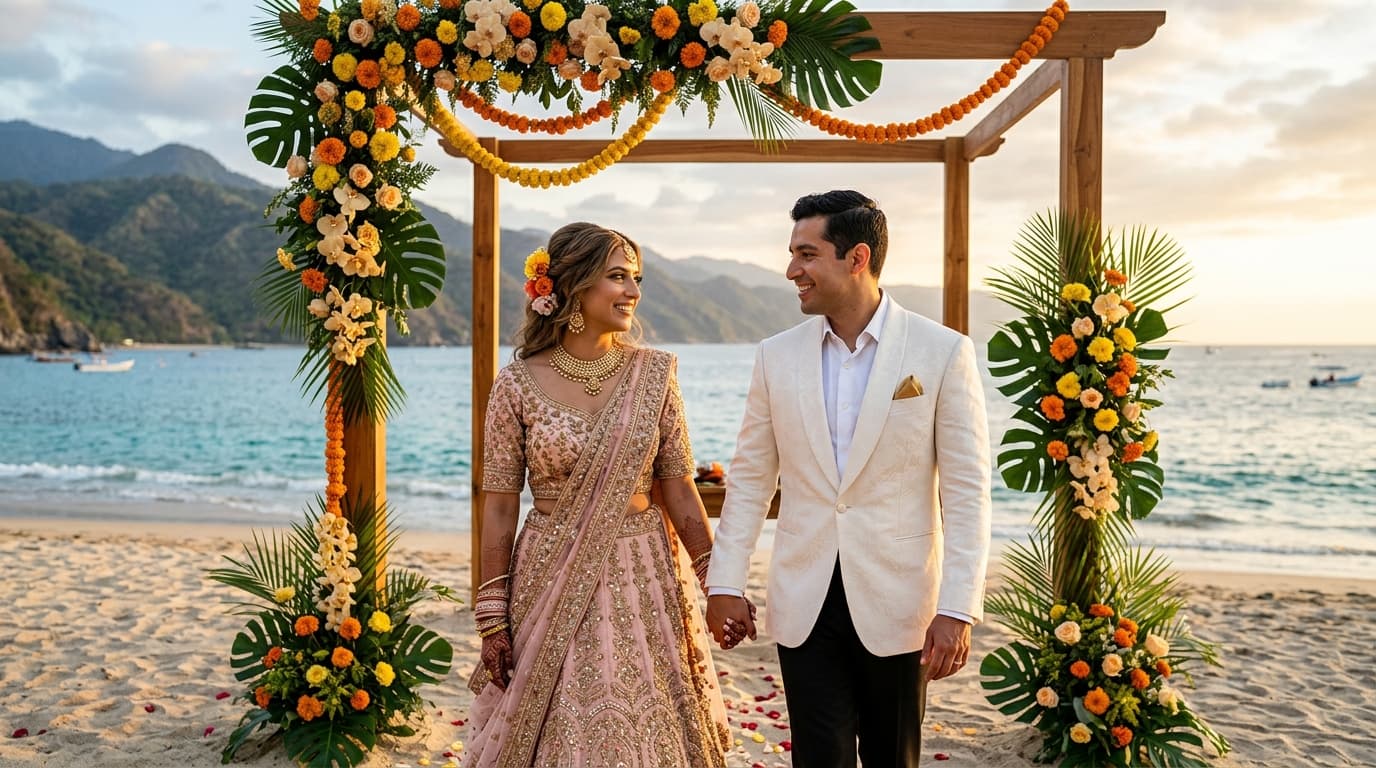
The Art of Dual-Heritage Beachfront Architecture in Banderas Bay
Planning an ultra-luxe destination wedding in Puerto Vallarta requires navigating the delicate intersection of environment, aesthetics, and cultural reverence. When honoring two rich, heritage-driven traditions—such as South Asian and Mexican customs—the beach becomes more than a backdrop; it functions as a dynamic canvas. Banderas Bay offers a dramatic topography where the Emerald Coast of the Sierra Madre Mountains meets the Pacific Ocean. However, merging multi-tiered ceremonial requirements like the South Asian Vedic wedding rituals with beloved Mexican traditions such as the Lazo (unity cord) and Las Arras Adornadas (ceremonial coins) upon the shoreline demands precise spatial planning, local logistical knowledge, and specialized structural engineering.
From the private cove enclaves of Conchas Chinas to the sprawling beachfront estates of Punta Mita, executing a seamless dual-heritage ceremony on the sand requires structural innovation that respects both ancient customs and delicate coastal environments.
Engineering the Coastal Mandap: Structural Stability and Fire Safety
At the center of a South Asian wedding ceremony is the Mandap, a sacred four-pillar canopy under which the bride, groom, parents, and officiating priest conduct the rituals. Translating this heavy, intricate architectural feature onto the shifting sands of Puerto Vallarta demands sophisticated engineering that balances cultural sanctity with beachfront logistics.
Navigating ZOFEMAT Regulations and Sacred Fire Dynamics
Mexico’s Federal Terrestrial Maritime Zone (ZOFEMAT) governs all oceanfront construction and environmental preservation. Installing a structural canopy requires temporary, low-impact footings that do not disturb local sea turtle nesting zones or coastal flora. Luxury production teams utilize customized subterranean steel weight plates buried beneath the top layer of sand, anchored by hidden counterweights disguised as terraced floral planters.
Furthermore, the central element of the Vivaha (wedding) is the Agni, or sacred fire, invoked in the Havan Kund. Maintaining a open flame on a windy Pacific shoreline presents unique challenges. Banderas Bay experiences prevailing afternoon thermals that shift as the sun dips behind the horizon. To ensure safety and ritual compliance without violating municipal fire codes or ZOFEMAT environmental directives, luxury event designers engineer custom copper or brass Havan Kunds fitted with recessed glass draft guards and internal ethanol-gel flame mechanisms. This technology preserves the visual and spiritual presence of the sacred fire while eliminating ash dispersion and smoke drift across the beach.
Substrate Security and Heavy Canopy Weighting
Unlike standard four-post wedding arches, a traditional or contemporary Mandap must accommodate up to eight adults simultaneously along with extensive floral sculptures. To prevent uneven settling on soft sand, structural planners construct elevated, sub-sand structural platforms using reclaimed native hardwoods. These foundations evenly distribute structural loads while giving the bridal party a stable, polished surface for key ceremonial movements like the Saptapadi (seven sacred steps).
Harmonizing Ritual Elements: From Agni to the Lazo on the Sand
Integrating South Asian and Mexican ceremonial rituals requires a thoughtful spatial choreography so that neither tradition feels peripheral. Rather than running two distinct ceremonies, high-luxe Puerto Vallarta weddings seamlessly blend ritual sequences within a unified timeline.
Olfactory Alignment: Copal and Sacred Dhoop
Olfactory elements play a powerful role in both Mexican and South Asian sacred rites. In traditional Mexican wedding blessings, particularly those rooted in regional coastal heritage, the burning of Copal resin purifies the surrounding space and welcomes divine energy. Similarly, South Asian ceremonies utilize Dhoop (incense) and aromatic herbs thrown into the Havan. Production teams harmonize these traditions by placing handcrafted ceramic incense burners along the oceanfront perimeter, creating a subtle, signature fragrance profile that blends indigenous Oaxacan copal with sacred Indian sandalwood, carried gently across the beach by sea breezes.
Ritual Spatial Flow for Saptapadi and Arras
Flow and movement are paramount when transitioning between sacred rites on the shoreline. Following the exchange of Jaimala (floral garlands woven with local marigolds and orchids), the couple transitions to the Lazo ritual. A custom-woven unity cord—often incorporating gold thread, Mexican silver beads, and sacred Indian silk—is placed around the couple’s shoulders in a figure-eight by designated godparents (Padrinos).
The physical space around the Mandap must allow uninterrupted movement for the family during the Arras presentation—where thirteen gold coins are passed to symbolize mutual prosperity—before transitioning directly into the Saptapadi. Designing wide, obstacle-free perimeter walkways around the central hearth ensures that elders wearing elaborate traditional garments move effortlessly over the sand.
Botanical and Aesthetic Fusion for Oceanfront Vows
Floral architecture serves as the visual bridge between South Asian brilliance and Mexican coastal elegance. Rather than importing out-of-season blooms, luxury floral designers in Puerto Vallarta source from native Pacific Northwest and Jalisco growers to create resilient, high-impact installations capable of withstanding ocean mist and direct heat.
- Marigold (Cempasúchil) & Bougainvillea Synergy: Bright orange and yellow marigolds—sacred in South Asian tradition and deeply symbolic in Mexican culture—are combined with vivid magenta bougainvillea harvested locally from Sierra Madre hillside estates.
- Subtropical Foliage Frames: Native monstera, traveler’s palm, and local fern fronds provide structural greenery that grounds bright floral clusters, creating a natural frame that complements the turquoise tones of Banderas Bay.
- Custom Garlands: Hand-strung Gajras made from local night-blooming jasmine and local Mexican tuberose (Nardo) offer a lush textural feel and high resilience against coastal humidity.
Luxury Guest Experience: Coastal Refreshments and Microclimate Comfort
A dual-heritage beach ceremony demands elevated guest hospitality designed around Puerto Vallarta’s warm tropical climate. As guests arrive at the beachfront venue, transition areas should offer immediate sensory comfort and curated refreshment.
- Artisanal Hydration Concierge: Serve chilled infusions that celebrate both culinary heritages, such as spiced Agua de Jamaica (hibiscus tea with subtle cardamom hints), fresh young coconut water harvested in Sayulita, and chilled Horchata spiked with Oaxacan vanilla bean.
- Thermal Comfort Elements: Provide handwoven Mexican palm fans alongside sandalwood parasols, allowing guests to stay comfortable during open-air afternoon vows.
- Customized Footwear Solutions: Offer elevated footwear transitions where guests can swap formal heels or leather oxfords for hand-stitched Mexican leather huaraches or embroidered silk slippers before stepping onto the sand.
By blending structural foresight, local environmental compliance, and deep reverence for both South Asian and Mexican traditions, couples can create an extraordinary, culturally rich oceanfront wedding that stands as a benchmark of modern destination luxury in Puerto Vallarta.