
The Legal Foundations of Private Estate Ceremonies in Puerto Vallarta
Hosting an extraordinary destination wedding within a secluded cliffside estate in Conchas Chinas or an expansive beachfront villa in Amapas offers matchless intimacy and architectural grandeur. However, orchestrating an officially binding civil ceremony within a private residence requires navigating the distinct legal framework of the State of Jalisco. While symbolic ceremonies remain a popular choice for international couples, executing a legally recognized matrimonio civil on estate grounds elevates the celebration, merging formal state ceremony with bespoke luxury hospitality.
Understanding the statutory requirements enforced by the Registro Civil de Puerto Vallarta is essential for seamless execution. Transforming a private villa terrace into an official municipal forum demands rigorous administrative preparation, precise document validation, and flawless day-of judicial coordination. For high-net-worth couples, mastering these legal protocols ensures that the official signing becomes an effortless, sophisticated milestone within the broader multi-day itinerary.
Navigating Jurisdictional Boundaries: Jalisco vs. Nayarit
A frequent point of confusion for destination couples is the geographic and legal division between the neighboring states of Jalisco and Nayarit. Banderas Bay spans both regions, yet the legal mechanisms governing private villa weddings differ significantly depending on the property's physical location.
Properties situated in classic Puerto Vallarta neighborhoods—such as Conchas Chinas, Amapas, Mismaloya, and Sierra del Mar—fall under the municipal jurisdiction of Puerto Vallarta, Jalisco. Conversely, estates in Punta de Mita, Real del Mar, or Sayulita operate under the municipal codes of Bahía de Banderas, Nayarit. A civil judge (*Juez del Registro Civil*) licensed in Jalisco cannot perform an official ceremony within Nayarit, nor can a Nayarit official validate a marriage on a Puerto Vallarta villa lawn. Securing the appropriate municipal official corresponding strictly to the estate’s legal address is the baseline requirement for property-based civil integration.
Required Documentation and Authentication Protocols
Executing an official civil marriage in a private Puerto Vallarta estate requires a meticulous timeline spanning six to twelve months prior to the wedding date. Every document generated outside of Mexico must undergo a rigorous chain of custody to achieve legal validity within the State of Jalisco.
- Apostilled Birth Certificates: Certified copies of both partners' birth certificates must bear an official Apostille issued by the Secretary of State (for US citizens) or relevant federal authority. This authenticates the document for official use in Mexico under the Hague Convention.
- Certified Official Translations: Foreign documents, including apostilles, must be translated into Spanish by an officially accredited state court translator (perito traductor) registered with the State of Jalisco. General translations are legally invalid for municipal marriage registries.
- Valid Passports and Tourist Cards (FMM): Both individuals must present valid passports along with their official immigration entrance documents (FMM), confirming legal presence in Mexico at the time of the signing.
- Pre-Marital Medical Certifications (Análisis Prenupciales): Mexican law mandates that couples complete pre-marital medical examinations—including blood typing (RH factor) and screening for STI/HIV. Crucially, these tests must be conducted locally in Puerto Vallarta by a certified Mexican laboratory within 14 days of the scheduled ceremony.
- Divorce or Death Decrees (If Applicable): If either party was previously married, official decrees showing dissolution must also be apostilled and officially translated by a Jalisco perito traductor.
- Witness Documentation: Four official witnesses must be present at the estate during the signing, equipped with valid passports and legal entry documentation.
Coordinating the Off-Site Judicial Protocol at the Estate
To execute a legal ceremony inside a private residence, planners must arrange an off-site judicial appearance, officially termed a matrimonio a domicilio. Municipal civil registry offices in Puerto Vallarta, such as Office No. 1 (Downtown) or Office No. 4 (Las Juntas), dispatch judges to private addresses upon formal petition and payment of municipal off-site administrative fees.
Judicial availability for estate visits is tightly regulated. Judges manage demanding daily court schedules, making punctual vehicular transportation and flawless estate gate clearance imperative. Private security teams at gated communities in Sierra del Mar or Conchas Chinas must receive advance clearance for official municipal vehicles to ensure zero delays in the judicial arrival time.
Designating a serene, climate-controlled setting for the administrative pre-signing is highly recommended before transitioning to the public terrace ceremony. The pre-signing requires formal verification of physical passports, review of local medical results, and thumbprint impression recording in the official state registry ledger (*Libro del Registro Civil*).
Integrating Sacred Symbolic Traditions with the Legal Decree
A primary design challenge during luxury estate weddings is seamlessly blending the formal legal decree with personalized symbolic or spiritual traditions. The official judicial ceremony conducted by a Mexican civil judge is inherently procedural, focused on statutory rights and legal declarations under Jalisco civil law.
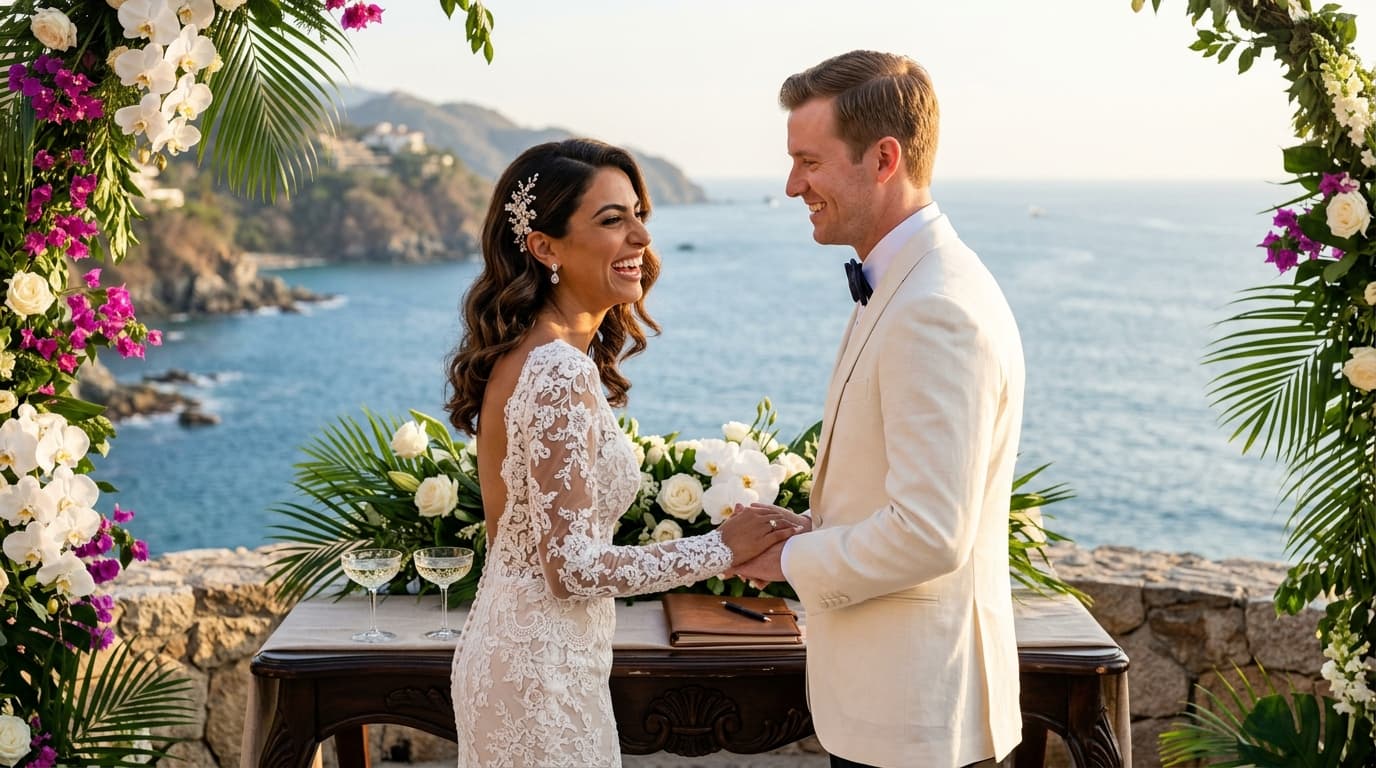
To maintain an elevated, emotionally resonant aesthetic, luxury itineraries often structure a two-part ceremonial flow. The formal legal signing and thumbprint impression can take place during a private, intimate moment on an upper estate balcony or inside the villa’s library alongside immediate family and witnesses. Following this legal validation, guests gather on the main oceanfront lawn for a fully customized symbolic ceremony led by a private officiant, incorporating personalized vows, cultural rituals, or musical performances against the panoramic backdrop of the Pacific Ocean.
Post-Ceremony Validation and International Recognition
Upon completion of the estate ceremony, the judge issues an official Mexican marriage certificate (Acta de Matrimonio). While this document legally validates the union in Mexico immediately, foreign governments require an official state apostille to recognize the document in the couple's home country.
The physical Acta de Matrimonio must be submitted to the Jalisco State Government headquarters in Guadalajara to receive its final international Apostille. Experienced luxury production teams manage this post-wedding courier protocol directly, delivering the fully legalized, apostilled marriage certificate to the couple’s international residence within four to eight weeks following their celebration in Puerto Vallarta.