
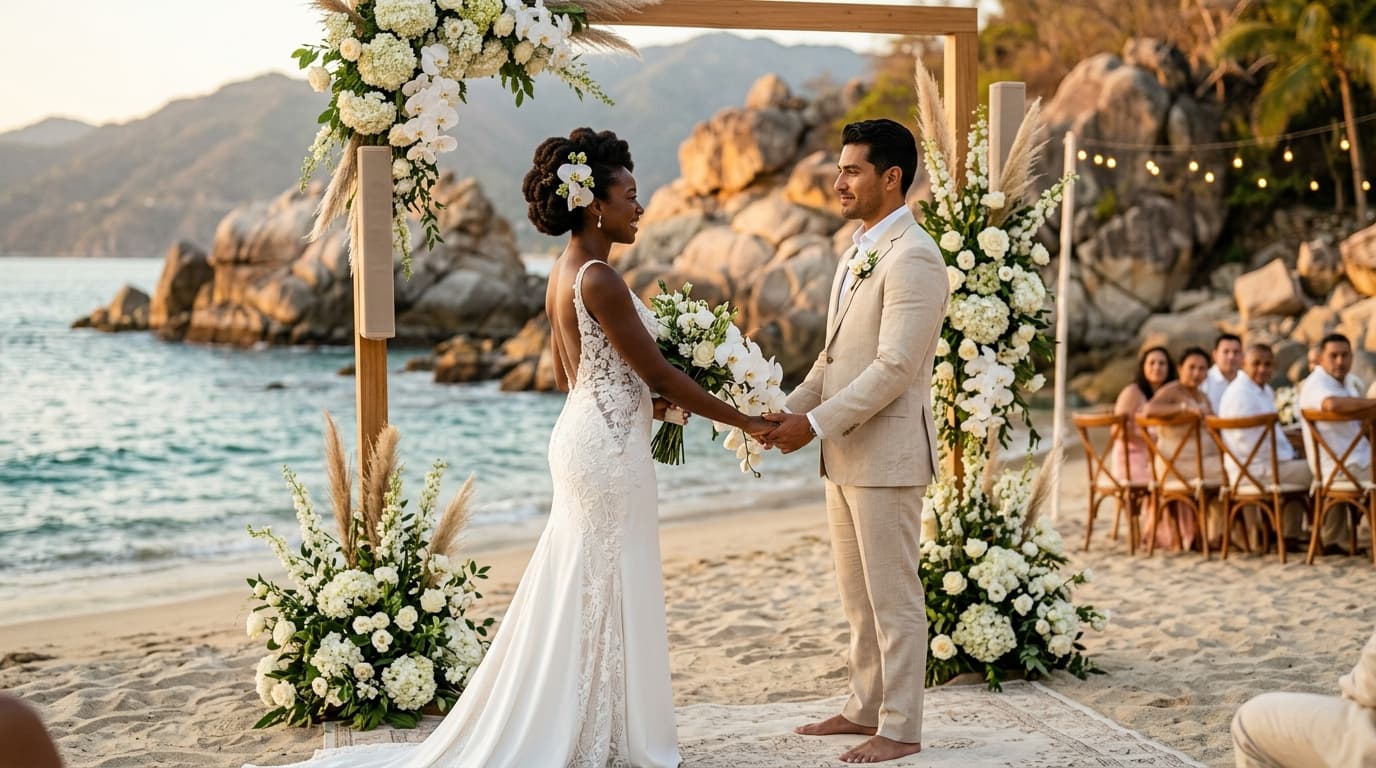
The Auditory Challenge of the Open Ocean
Standing at the ocean's edge along Puerto Vallarta’s dramatic South Zone—where steep granite cliffs meet the deep turquoise waters of Banderas Bay—the natural soundscape is undeniably romantic. However, from an acoustic production standpoint, the oceanfront presents a formidable technical challenge. The continuous, low-frequency roar of breaking waves (typically oscillating between 60 Hz and 250 Hz) combined with wind currents descending from the Sierra Madre Mountains can easily drown out soft spoken vows, ambient acoustic strings, and delicate emotional nuances. For an ultra-luxury shoreline wedding, crisp, intimacy-preserving sound is non-negotiable. Every whisper, vow, and musical flourish must reach guests with pristine fidelity without feeling artificially amplified or abrasive.
Decibel Mapping and Banderas Bay Aerodynamics
Designing an elevated acoustic environment for a beach ceremony requires an understanding of localized coastal physics. Wave action along a private cove in Conchas Chinas behaves quite differently from the broad, rolling surf along Punta Mita or the calmer waters of northern Nuevo Vallarta.
Decibel Profiling by Shoreline Topography
- Granite Coves (Conchas Chinas & Mismaloya): Ocean swells hit rocky outcrops, generating higher-frequency white-noise spray and localized acoustic reflection off cliff faces.
- Open Sand Stretches (Flamingos & Punta de Mita): Sweeping ocean views come with sustained, low-frequency surf rumbles that spread horizontally across expansive sandy flats.
- Elevated Oceanfront Terraces: High wind shear along elevated bluff edges introduces turbulence, requiring specialized physical wind-screening and localized directional audio aiming.
To master these variables, luxury production teams perform pre-event decibel mapping and micro-environmental acoustic profiling. By cross-referencing tide schedules and wave swell predictions specific to your ceremony hour, audio engineers construct a customized acoustic perimeter designed to isolate human vocal frequencies from ambient ocean noise.
Discreet Architectural Integration of Line-Array Technology
Bulky, industrial sound equipment has no place in a high-design coastal aesthetic. Modern luxury weddings rely on architectural line-array column speakers. These slim, minimalist vertical arrays project sound in a tightly controlled horizontal plane rather than a wide vertical dispersion, preventing audio waves from bouncing off the sand or dispersing uselessly into the sky.
Concealing Audio Systems Within Custom Spatial Installations
True luxury acoustics should be heard perfectly while remaining completely invisible to guests and camera lenses. Audio components can be seamlessly woven into your overall floral and spatial design:
- Tone-Matched Camouflage: Speaker columns wrapped in custom-dyed linen, natural woven rattan, or lush tropical greenery that blend seamlessly into altar structures.
- Sub-Sand Conduit Channels: Signal cables buried in waterproof conduit beneath dry sand or concealed under custom elevated timber walkways.
- Decoupled Structural Mounts: Shock-absorbing rubberized mounts that isolate audio gear from physical vibration caused by wind or heavy bass resonance.
Specialized Microphones and Wireless RF Engineering
High relative humidity in Puerto Vallarta—especially during late afternoon solar transitions—can dampen traditional microphone diaphragms, while ocean breezes create disruptive wind noise on standard audio pickups.
Hydrophobic and Wind-Resistant Transmitters
To deliver uncompromising vocal clarity, ceremony setups utilize omnidirectional sub-miniature lavalier microphones featuring hydrophobic coatings. These moisture-resistant capsules block sea spray and high humidity from degrading signal performance. Pair these with custom-tinted acoustic fur windscreens that match officiant attire or subtle wardrobe details, and wind distortion is effectively eliminated even in coastal gusts exceeding 15 knots.
Furthermore, digital wireless systems operating on broad-spectrum UHF channels bypass signal congestion caused by nearby maritime communication systems and local resort networks along the bay, ensuring uninterrupted transmission during key ceremonial moments.
Spatial Audio Zoning for Intimate Ceremony Layouts
Blasting high-volume audio from a central pair of front speakers creates an uneven guest experience—uncomfortably loud for front-row family and faint for guests seated further back. Luxury shoreline sound relies on multi-zone spatial audio distribution.
Phase-Aligned Multi-Zone System Design
- Altar Micro-Fill Zone: Concealed, ultra-compact fill speakers tucked into ground-level floral arrangements provide soft, natural sound reinforcement directly to the couple and officiant, eliminating feedback risks.
- Guest Pavilion Array: Mid-field directional column speakers angled downward into the seating area at precise 15-degree trajectories to deliver even coverage across all rows.
- Perimeter Delay Clusters: Millisecond-synchronized delay speakers positioned at the rear perimeter maintain crystal-clear audio clarity without creating distracting echoes.
Harmonizing Live Musicians with Natural Ocean Waves
Incorporating live instrumentation into an oceanfront ceremony requires delicate acoustic balancing. Unamplified instruments—such as cellos, Spanish guitars, or pedal harps—possess subtle tonal warmth that can easily be overwhelmed by the Pacific surf.
By utilizing boundary microphones mounted directly to instrument soundboards and combining them with organic sound-isolation baffles—crafted from warm teak or acoustically damped fabric panels—live musicians produce a rich, resonant sound. The result is a exquisite blend of live music and natural ocean rhythms, offering guests a transcendent audio experience that honors both the breathtaking landscape and the emotional depth of your vows.